
Research Learning Experiences (RLE)
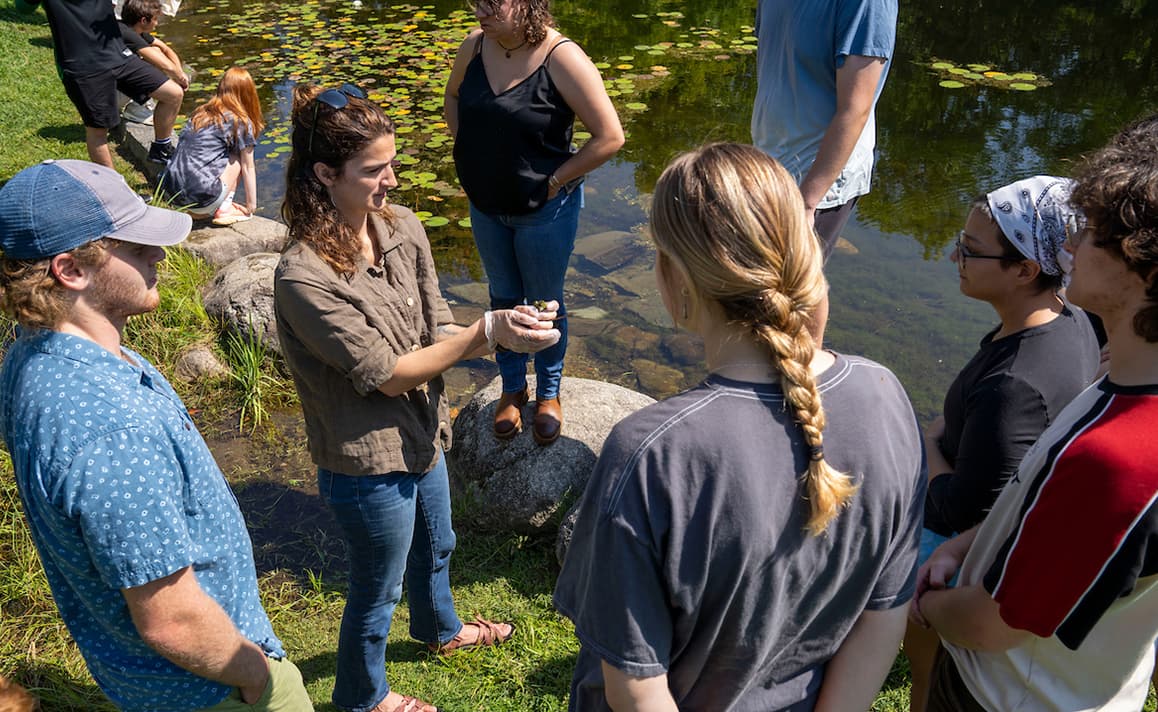
The UMS TRANSFORMS Student Success and Retention Initiative, with funding from a grant provided by the Harold Alfond Foundation, supports a developmental pathway based upon three sub-initiatives: Research Learning Experiences (RLEs), Gateways to Success (GTS), and Pathways to Careers (PTC). The Research Learning Experiences (RLE) program is a signature sub-initiative of the University of Maine System’s UMS TRANSFORMS effort, designed to provide every first- and second-year student across seven campuses with access to immersive, hands-on, small-cohort learning experiences. Grounded in research and creative problem solving, these one-credit courses begin with an intensive “bridge week” and are directly tied to fall-semester coursework. RLEs are intended to foster student identity, agency, and sense of purpose from the very beginning of college—especially for students who may not otherwise see themselves as researchers or creators. GTS helps students to overcome challenging courses by providing additional support in the classroom and/or via advising. PTC helps students explore careers by connecting them to internships to apply skills and knowledge learned in professional settings. Here we focus on the UMS RLE courses.
Problem / Rationale
Many students, including those from historically underrepresented groups or without prior access to academic enrichment opportunities often miss out on high-impact experiences that are proven to boost confidence, belonging, and long-term academic success. Internships, research opportunities, and faculty relationships are often reserved for upper-level students. RLEs flip this model, offering these experiences to students as soon as they arrive on campus and ensuring equitable access to mentorship, collaborative learning, and purposeful inquiry.
How It Works
The Research Learning Experiences (RLE) program is embedded across the University of Maine System through a shared curricular structure, cross-campus coordination, and a common commitment to early, high-impact learning. Each participating campus offers first- year students a cohort-based, inquiry-driven course that begins with an intensive bridge week or includes an immersive experience that continues through the course. These courses are paired with foundational general education coursework and designed to build research identity, collaboration skills, and personal agency. Students explore real-world problems in disciplines ranging from science to the arts, supported by faculty mentors who guide them through iterative, hands-on learning. The RLE model is coordinated through system-wide working groups, common assessment tools, and structured faculty development, allowing for both campus-specific adaptation and system-level coherence. The following outlines the University of Maine’s RLE structure.
RLE Structure:
- Each RLE begins with a weeklong bridge experience or immersive experience, creating strong cohort bonds and building foundational research skills.
- The bridge week is followed by a course in the fall, where students continue exploring open-ended questions or creative problems within disciplines ranging from engineering and the sciences to the arts and humanities.
- The immersive experiences are conducted throughout the semester to ensure that students have hands-on opportunities to participate in research and work with data in the context of the classroom
- RLEs are embedded within students’ broader academic schedules and designed to be highly interdisciplinary and applied.
Core Elements:
- Small cohort model (typically 15-25 students) to foster community and individualized faculty interaction.
- Tangible outcomes such as experiments, presentations, or performances that reinforce student agency.
- Emphasis on group collaboration, iterative design, and the power of failure as a path to discovery.
- Development of key skills like communication, teamwork, and inquiry that prepare students for later internships, research assistantships, and careers.
- Common learning outcomes were developed to support coherence across the RLE program. These outcomes focus on topic selection and research questions, iterative process for exploration, communication, and responsibility for the discovery process.
Faculty Engagement:
- Faculty apply through an RFP process to develop and teach RLEs.
- Faculty receive support through workshops, peer feedback, and assessment tools developed collaboratively across campuses. Additionally, faculty receive additional support to disseminate their integration of teaching and research via funding for page charges for peer-reviewed publications or travel to conferences.
- Faculty contribute to program assessment planning and research through a campus-wide assessment committee.
Below is a quote from a highly involved RLE faculty member about benefits of engagement with the RLE program:
"I have launched an area of research in STEM ed because I saw first hand in this class and EES 217 that experiential learning seemed particularly effective, and I wondered what about it facilitates those gains. So far, this work has supported 1 PhD student, 1 Masters student, and 1 undergraduate student."- Katharine Ruskin
How It Was Implemented
- Pilot Stage (2021–22): RLEs launched at the University of Maine and University of Maine at Machias. Courses spanned multiple disciplines and were supported by bridge week programming and system-wide assessment tools.
- System Expansion (2022–24): RLEs scaled to additional campuses, UMaine at Augusta, Farmington, Presque Isle, Fort Kent, as well as the University of Southern Maine.
- Cross-Campus Coordination: A centralized assessment team and cross-institutional working groups (with representatives from all seven universities) guided design, training, and implementation, with support from senior leadership including deans, provosts, and presidents.
- Connection to Broader Reform: RLEs operate in tandem with two other UMS TRANSFORMS initiatives: Gateways to Success (intro course reform) and Pathways to Careers (career-connected learning), creating a continuous arc of transformational learning.
Assessment & Evidence
Assessment of RLEs includes both dispositional and cognitive outcomes:
Cognitive
- Students will formulate appropriately scoped topics or questions that will guide their inquiry.
- Students will describe their iterative approaches to exploration for work without a defined answer.
- Students will effectively communicate with collaborators inside or outside of the classroom about their experience.
- Students will demonstrate responsibility for the discovery process.
Dispositional
- Students will identify the relevance/applicability of their experience beyond the RLE course.
- Students will reflect on how their exploratory process has helped them develop as learners.
- Students will explain the importance for their learning of belonging to a community.
Assessment Tools
- Pre- and post-course student surveys measuring identity, agency, and sense of purpose
- Instructor-completed rubrics evaluating skill development
- Faculty and staff surveys on implementation, challenges, and future participation
- Longitudinal tracking of retention, academic performance, and post-graduate success
Student Impact
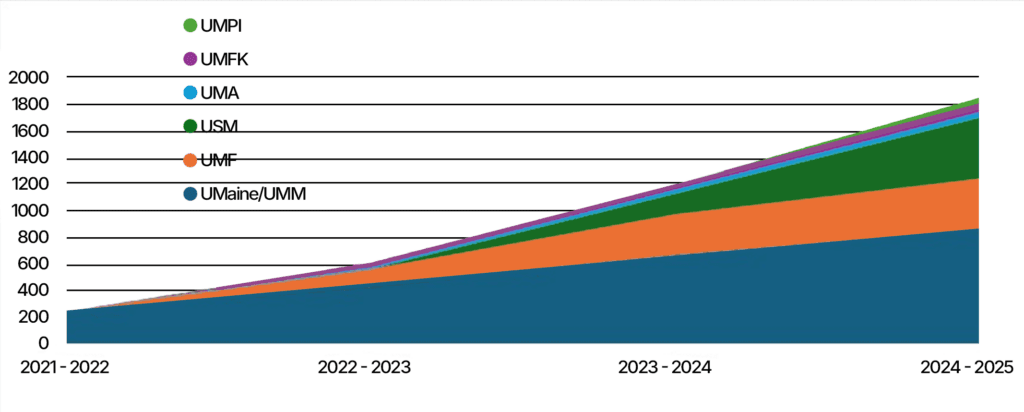
- There has been consistent growth over the past five years.
- In fall 2025, 37% of first-year students in the UMaine System participated in RLEs during their first semester.
- The following are highlights of findings from some of the research conducted at UMaine regarding sense of belonging and student experiences:
- Compared to non-RLE peers, and controlling for student characteristics, RLE participants showed higher pre-post gains with respect to sense of belonging to UMaine and in the course, and research identity.
- Compared to non-RLE peers, and controlling for student characteristics, RLE participants who responded to the Gallup/CTE survey in spring 2025 reported more Gallup Big Six experiences 1 - 3 years after their participation (2.89 for RLE students and 1.97 for non-RLE students.
Evidence: Peer Reviewed Publications
Adelman, N. E., Cromarty, L., Francis, S. M., Griciute, V. E., Hart, J. N., Hoffpauir, A., Koss, R., Kumar, R., Matonsi, M. N., Morrison, E., Paiement, G., Perley, A., Plichta, A., Rodrigues, L., Neely, M. N., Wiafe-Kwakye, C. S., & Molloy, S. D. (2025). Characterization of four cluster A1 Mycobacterium phage genomes, Applejack, Hermia, LilBib, and QTRlifeCrisis. Microbiology Resource Announcements, 14(11), 1-4. https://doi.org/10.1128/mra.00244-25
Brooks, M., & McCue-Quinn, B. (2025, August 13). Solving Real-World Problems, One Cohort at a Time. AACSB Insights. https://www.aacsb.edu/insights/articles/2025/08/solving-real-world-problems-one-cohort-at-a-time
Parsons, K. L. (2021). The Impact of Diet Quality on Health-related Quality of Life in College Students (Master of Science Thesis). The University of Maine. DigitalCommons@UMaine. https://digitalcommons.library.umaine.edu/etd/3532.
Parsons, K., Strout, K., Winn, C., Therrien-Genest, M., Yerxa, K., & McNamara, J. (2024). Development of Master Chef: A Curriculum to Promote Nutrition and Mindful Eating among College Students. International Journal of Environmental Research and Public Health, 21(4), 487. https://doi.org/10.3390/ijerph21040487.
Ruskin, K. J., Wood, Z. T., White, H. C., O’Brien, S., & Allen, D. M. (2024). Short, early field research courses as a model to increase equity in ecology. Ecosphere, 15(6): e4912. https://doi.org/10.1002/ecs2.4912
Schwartz-Mette, R. A., Sapp, M., & Strout, K. (2025). Online and In-Person Mindfulness-Based Stress Reduction (MBSR) Improves Stress Resilience in Nursing Education. Worldviews on Evidence-Based Nursing. https://doi.org/10.1111/wvn.70031
Strout, K., Gayer, K., Sapp, M., Schwartz-Mette, R. A., & O’Brien, L. (2025). Reducing burnout and enhancing mindfulness: a prospective longitudinal study of a wellness curriculum for first-year nursing students. Journal of American College Health. https://doi.org/10.1080/07448481.2025.2583204.
Strout, K., Sapp, M., Parsons, K., Schwartz-Mette, R., McNamara, J., & Smith, A. (2025). Thrive and Flourish: A Holistic Approach to Nurturing Wellness and Resilience in Nursing Students. Journal of Nursing Education, 64(8). https://doi.org/10.3928/01484834-20240925-03.
Strout, K., Schwartz-Mette, R., McNamara, J., O’Brien, L. M., Parsons, K., Walsh, D., Bonnet, J., & Sapp, M. (2025). An Emotional and Physical Health Profile of Students Enrolled in a Public Nursing Program: A Cross-Sectional Study. Journal of Nursing Education, 64(3), 156–161. https://doi.org/10.3928/01484834-20241030-02.
White, H. C., Allen, D. M., Buffinton, K., Humphrey, D., Malpiede, M., Miller, R. K., & Volin, J. C. (2024). Cultivating long-term well-being through transformative undergraduate education. PNAS Nexus, 3(9), pgae372. doi: 10.1093/pnasnexus/pgae372.
White, H. C., Ruskin, K. J., Allen, D. M., McLagan, K. B., Nelson, S. J., & Jolley, A. (2025). Effects of a Weekend- Long Field Course on Undergraduates' Confidence, Identity, and Belonging. Ecology and Evolution, 15, no. 12: e72517.https://doi.org/10.1002/ece3.72517White, H. C., Ruskin, K. J., Jolley, A., Flint, N., Allen, D. M., Pelletreau, K. N., Olsen, B. J., Ferrini‑Mundy, J. E., & Volin, J. C. (2025). Research Learning Experiences for First‑Year Undergraduate Students: Belonging, Research Identity, and Retention. Research in Higher Education, 66(17). https://doi.org/10.1007/s11162-025-09836-8.
Scalability
The RLE model was designed from inception for system-wide adoption. Key features of its scalable infrastructure include:
- Centralized faculty development and resource sharing
- Flexible course design adaptable to a wide range of disciplines
- Shared assessment tools and data infrastructure
- System-level leadership buy-in and integration with workforce and equity goals
Due to early success, the program was scaled to all system campuses by the 2023-24 academic year.
Contact
Dr. T. Scott Marzilli
Senior Associate Provost of Student Success and Innovation
Scott.Marzilli@maine.eduDr. Sydne Record
Executive Director of UMS TRANSFORMS Student Success and Retention Initiatives
Sydne.Record@maine.eduMore in Classroom-Based Innovation
The 4D Experience at the University of Denver
The Four-Dimensional (4D) Experience is a university-wide strategic imperative at the University of Denver that prepares students for lifelong learning, engagement, and flourishing. It does so through nurturing students’ growth across the four dimensions of intellect, character, well-being, and purpose, both in and out of the classroom. Championed by senior leadership, the initiative focuses on […]
University of Denver